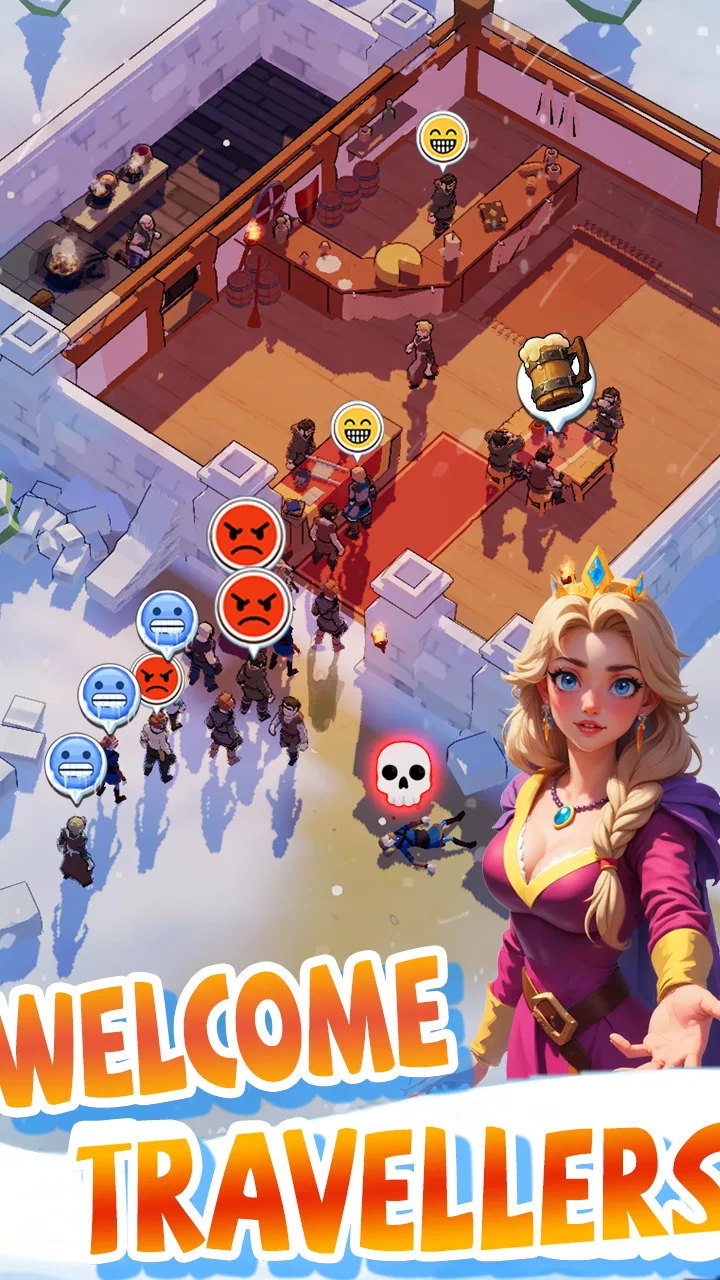
Tavern Master
- 4.3
- Rating
- 500.00K
- Installs
- Free
- Price

 Analysis by App-foxy
I went into Tavern Master expecting a light strategy game built around the fantasy of running a busy drinking house, and that is exactly the kind of experience it presents. The central appeal is easy to understand: you take responsibility for your own tavern, shape it over time, and try to turn a modest establishment into a place people want to visit. It is aimed at players who enjoy planning, crafting, decorating, and making gradual progress rather than controlling a battlefield or solving one fixed puzzle.
The game is free to start, which makes the first decision simple. You can try the core experience without paying an entry fee, while optional in-app purchases range from $0.99 to $99.99 per item. That difference matters when judging its value: the free access gives curious players room to test the style, but anyone who dislikes purchase prompts or progression systems influenced by spending should approach it carefully. My overall impression is that its strongest quality is the setting. Managing a tavern feels more personal than managing an abstract empire, and the theme gives ordinary strategy choices a welcoming personality.
Running a tavern feels more personal than managing a typical strategy game
The game comes from ARK GAME LIMITED and sits in the strategy category, although it is much friendlier than the word “strategy” may suggest. I would not compare it directly with a complex grand-strategy title that expects spreadsheets, long campaigns, or detailed military planning. Its appeal is closer to building a small, lively business and deciding how to use limited resources as the establishment grows.
You May Also Like

 Blood Strike: 2.5 Anniversary
Blood Strike’s Loadouts Turn Every Drop Into a Tactical Gamble
A close look at Blood Strike’s custom loadouts: how fast access to signature weapons reshapes its battle royale rhythm, rewards preparation, and narrows the gap between fights.

 Pandora - Music & Podcasts
Pandora’s Music Is Easy to Start, but Harder to Recover
Pandora’s strength is its low-effort path from a seed to a station. Its weak spot is how much confidence it asks you to place in connection, setup, and quiet recovery.

 8 Ball Pool
 Is Built on Rivalries, Rematches, and Routine
A close look at the rivalries, rematches, shared routines, and unanswered safety questions that turn a quick pool match into a persistent mobile community.

 Samsung Music
’s Quiet Strength Is Playing What You Already Own
Its reach comes less from spectacle than from dependable access to a personal library. That simplicity is both the app’s strongest retention engine and its ceiling.

 AccuWeather: Weather Radar
AccuWeather Review: A Quick, Clear Forecast for Everyday Decisions
For everyday plans, the best forecast is the one you can understand quickly. AccuWeather makes rain timing, radar, and local conditions easy to act on, with a few trade-offs.

 Hill Climb Racing
Why Hill Climb Racing Still Turns Crashes Into One More Run
A tiny car, a bumpy hill and one more upgrade: Hill Climb Racing keeps resurfacing because its simple chaos makes every near-miss feel personal.
More From Our News Desk
View All News


That makes it approachable for short sessions. I can imagine opening it during a break, checking what needs attention, making a few decisions, and leaving without feeling that I have abandoned a complicated campaign. At the same time, the tavern theme gives those small tasks a clear purpose. Crafting is not just a detached production menu; it supports the identity of the place. Design is not merely cosmetic decoration; it is part of making the tavern feel like my own.
The store summary focuses on designing, crafting, and enjoying the role of Tavern Master. In practice, those three ideas create the game’s basic rhythm. I look at the current state of the establishment, decide what deserves attention, prepare or improve something useful, and then return to see how the changes affect the next stage of play. That loop is more relaxed than competitive strategy, but it still rewards players who plan instead of tapping through every available option immediately.
Design choices are more important when resources are limited
The most interesting part of this kind of game is not placing the first attractive item. It is deciding what to do when several improvements seem appealing at once. A new decorative touch may make the tavern more inviting, while a practical upgrade may help the business move forward. Crafting may require materials that would be better saved for a later project. I found that the pleasure comes from choosing a direction and living with the consequences for a while.
My advice is to avoid spending every resource as soon as it becomes available. Keep a small reserve for the next meaningful improvement, especially when you are still learning how the progression works. This is a simple habit, but it prevents the common frustration of reaching an interesting option and discovering that a previous impulse purchase left you short of what you need.
Another useful approach is to give each play session one purpose. Instead of trying to improve every part of the tavern at once, I would focus on crafting, layout, or general progression during a particular visit. That reduces the sense of menu hopping and makes it easier to notice which decisions actually help. It also makes the game feel less like a checklist and more like a small management project.
Crafting gives the game a practical reason to keep returning
Crafting is important because it turns waiting and collecting into preparation. Even when I am not making a major change to the tavern, I have a reason to think about what should come next. The best way to use this system is to plan around a goal rather than manufacture things randomly. If the next improvement needs a particular group of materials, I would prioritize that route and avoid wasting resources on items that do not support the current plan.
This is also where the game can test patience. Players who enjoy gradual progress will probably appreciate having a project in the background. Players who want constant action may find the rhythm too slow, particularly if advancement depends on returning later or repeating familiar tasks. The tavern setting softens that repetition, but it does not remove the underlying management trade-off.
I also recommend treating the crafting screen as a planning tool, not just a place to collect rewards. Before confirming a project, consider whether it improves the part of the tavern you actually care about. A player focused on appearance will make different choices from someone who wants the fastest route through progression. That freedom is valuable, but it means the game does not always tell you which choice will feel most satisfying for your personal style.
A realistic everyday session
Imagine opening the game after work with only a few minutes available. I would first inspect the tavern, check which project is closest to completion, and decide whether the available materials support a useful craft. If they do, I would start that project, make one deliberate design change, and stop there. On a longer evening, I could return to compare the new arrangement with the previous one and decide whether the next investment should be practical or visual.
This is where the game makes the most sense to me. It does not need to dominate an entire evening to feel worthwhile. It works as a gentle routine: a quick visit to maintain momentum, followed by a longer session when I actually feel like planning. That flexibility is a genuine strength for people who enjoy mobile games in small portions.
The same scenario also reveals a weakness. If you want a game that delivers a dramatic event every time you open it, a tavern-management structure may feel uneventful. Its satisfaction depends on noticing small improvements and caring about the place you are building. Without that interest, the routine can become repetitive faster than it does in a more action-heavy strategy game.
Cost, value, and the limits of free access
The financial arrangement is straightforward enough to explain. Tavern Master is free to download and play, with optional purchases priced from $0.99 to $99.99 per item. I would therefore judge it in two stages: first, whether the free version gives enough room to understand the game, and second, whether optional spending feels worthwhile for a player who already enjoys the loop.
Free access is a real advantage here because the theme is specific. Not everyone will know in advance whether they enjoy crafting and running a virtual tavern. Being able to try it before paying removes much of the risk. I would use that early period to test three things: whether the pace feels comfortable, whether the design choices are satisfying, and whether the game remains enjoyable when I play without buying anything.
The presence of optional purchases changes the value discussion, but it does not automatically make the game poor value. A purchase can be reasonable if it saves time for someone who already likes the experience and understands what they are buying. It is less attractive if the player is using money to escape a progression rhythm they never enjoyed in the first place. My rule would be simple: play for free until the game has demonstrated that the tavern itself is fun, then decide whether convenience is worth paying for.
I would also avoid treating the largest purchase option as a normal part of the experience. The fact that items can reach $99.99 means a careful spending limit is sensible, particularly on a device shared with family members. The game is free to begin, but “free” should not be confused with “without optional spending pressure.” Anyone who prefers a single upfront price may feel more comfortable with a premium strategy game that has no in-app purchase range to consider.
What the game delivers without requiring a purchase
The free starting point delivers the main fantasy: I can enter the role of a tavern owner, make design decisions, work with crafting, and see whether the management loop suits me. That is enough to evaluate the game honestly. I do not need to commit money merely to discover whether the setting and pace appeal to me.
Its value is strongest for players who enjoy ownership. The tavern is not just a level to clear; it is a project that becomes more meaningful as I make choices about it. Even a small change can feel worthwhile when it reflects my preferred style. This personal connection is something many conventional strategy games lack, especially those built around identical maps, fixed armies, or purely numerical upgrades.
There is also value in the game’s accessibility. The minimum operating-system requirement is Android 6.0, so it is not aimed only at owners of the newest phones. The current version is 1.2.3, and the game carries a Teen content rating. Those details make it easier to understand the intended audience: older children and adults who want a strategy-themed management game rather than a title designed specifically for very young players.
The public response is encouraging without being a reason to skip personal testing. It has an average rating of 4.4 from around fourteen thousand ratings, with more than five hundred thousand installs. I read those figures as evidence that the concept has found an audience, not as proof that every player will enjoy the pacing. A tavern simulation can be well received and still be the wrong choice for someone who wants intense competition or deep tactical combat.
Where the trade-offs become noticeable
The first trade-off is tempo. A relaxed management game asks me to appreciate incremental progress. If I prefer immediate rewards, fast matches, or constant tactical surprises, the same structure may feel slow. The more I value atmosphere and gradual improvement, the more likely I am to enjoy it.
The second is attention. Design and crafting can be satisfying, but they also ask me to remember goals and manage resources. Players who simply tap every highlighted option may progress, yet they may miss the more thoughtful side of the game. I get more from it when I pause before committing materials and decide what kind of tavern I am trying to build.
The third is spending discipline. Optional purchases create a choice between patience and convenience. That is not automatically negative, but it does mean the game suits players who are comfortable setting boundaries. I would disable or protect purchasing access on a shared device and decide on a personal budget before experimenting with any optional item.
Compared with a traditional city builder, Tavern Master feels narrower and more characterful. A city builder usually offers a larger civic problem, with roads, services, population, and broad economic planning. This game’s tavern focus is more intimate, which makes it easier to understand but potentially less expansive. Compared with a competitive strategy game, it is calmer and more private. There is less pressure to outthink another player and more emphasis on shaping a place at my own pace.
That comparison helps clarify who should skip it. I would not recommend it to someone searching for serious tactical battles, a large-scale empire campaign, or a strategy game where every decision produces an immediate high-stakes result. I would also hesitate to recommend it to anyone who dislikes in-app purchases on principle, even though the game can be started for free. A paid, self-contained alternative may be a better fit for that audience.
Who is most likely to get lasting value?
I think Tavern Master is best for players who enjoy cozy management with enough planning to make choices matter. It suits someone who likes arranging a personal space, collecting what is needed for a project, and returning later to see steady progress. It is also a good match for people who prefer short mobile sessions rather than games that demand uninterrupted concentration.
It can work for a strategy fan who wants something lighter between more demanding games. The tavern theme gives the familiar resource-and-improvement loop a warmer identity, while the free entry makes experimentation easy. Parents and older players should still remember the Teen rating and the presence of optional purchases when deciding whether it is appropriate for a shared device.
My strongest practical tip is to judge the game by its free routine, not by the most attractive future upgrade. If the basic act of checking the tavern, planning a craft, and making a design decision already feels rewarding, the game has a good chance of holding your interest. If that loop feels like work before any purchase is made, spending more will not solve the underlying problem.
I would also recommend taking screenshots or simply remembering why you made major design changes. That may sound unnecessary, but it helps when experimenting with the layout or direction of the tavern. Without a clear personal goal, it is easy to make changes because they are available rather than because they improve the experience you want.
My verdict on downloading and spending
After spending time with it, I see Tavern Master as a pleasant, focused strategy game rather than a replacement for a full city builder or competitive tactics title. Its free starting point is the right approach: it lets me decide whether the tavern fantasy, crafting rhythm, and gradual design work are enjoyable before money enters the picture.
The best value is found by playing patiently and spending only after the free loop has earned your trust. That is especially important because the optional purchase range extends from small amounts to a much larger top-end item. I would not recommend buying impulsively to speed through a section that already feels repetitive.
For me, the game is worth trying if I want a calm, personal management experience with a clear tavern identity. I would download it for a relaxed routine, a little creative control, and the satisfaction of building something that feels like mine. I would skip it if I wanted deep warfare, a fixed-price experience, or nonstop action. With an average rating of 4.4 and a growing player base, it has clearly connected with many people, but its real strength remains more specific: it makes small strategic decisions feel like part of running a place I care about.
FAQs for Tavern Master
01What is Tavern Master and what can I do in the game?
Tavern Master is a simulation and management game where you build and manage your own medieval tavern. Players can customize their tavern, hire staff, manage resources, and serve guests. The goal is to create a successful and thriving establishment by expanding and upgrading your tavern, attracting more customers, and fulfilling quests.
02Is Tavern Master free to play, or does it require any in-app purchases?
Tavern Master is free to download and play, but it does offer in-app purchases. These purchases can enhance gameplay by providing additional resources, unlocking exclusive items, or speeding up progress. While the game can be enjoyed without spending money, some players may find purchases helpful for faster advancement.
03What are the system requirements for playing Tavern Master on mobile devices?
To play Tavern Master smoothly, ensure your device meets the minimum system requirements. For Android, it typically requires Android 5.0 or higher, while iOS devices need iOS 10.0 or later. Adequate storage space and a stable internet connection are also recommended to ensure optimal performance.
04How does Tavern Master handle player progression and difficulty levels?
Tavern Master offers a gradual progression system where players start with a basic tavern and unlock new features by completing tasks and earning rewards. The game balances difficulty by introducing challenges that increase as you advance, ensuring a rewarding experience for both beginners and seasoned players.
05Are there any social or multiplayer features in Tavern Master?
Tavern Master focuses primarily on single-player gameplay, allowing players to immerse themselves in managing their tavern. However, it does include social features such as leaderboards where players can compare their progress with friends and global players, adding a competitive edge to the experience.
Pros
- Intuitive and user-friendly interface.
- Engaging progression system keeps you hooked.
- Variety of customization options available.
- Smooth performance with minimal glitches.
- Regular updates with new features.
Cons
- In-app purchases can be quite pricey.
- Some tasks feel repetitive over time.
- Limited multiplayer interaction options.
- Occasional ads disrupt gameplay flow.
- Requires constant internet connection.

Tavern Master
Gallery